This week’s blog comes from Jamey Calloway, Product Management Specialist
The growth of wireless access points and other IP-enable devices, such as surveillance cameras and building automation devices has created a need to change the way typical horizontal links and channels are configured for these applications. Devices such as wireless access points mounted in non-traditional locations (in the ceiling or high up on the wall) are not attached to the network using standard faceplate/jack and patch cord. The traditional method is being replaced with direct attachment where the horizontal cable is terminated with a field installable plug and then plugged directly into the equipment (See Figure 1).
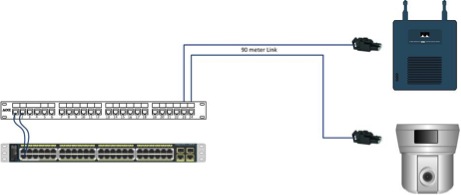 Another market driving the direct attach method is IP surveillance and building automation systems. Total building automation and controls system is expected to be a $50 billion market by 2018. Cameras and other security devices are also connecting to the network without the standard faceplate/jack connection point. The security market is experiencing significant growth as more security devices are migrating from analog to digital (Ethernet based). These security devices are even being added to the network via the direct attach method in existing commercial space where the computer network is not growing.
Currently, installers in the field are utilizing modular plugs that are intended for patch cord construction to terminate Cat5e and Cat6 cabling. This practice is difficult, time consuming, yields unpredictable performance results and is not recommended by the TIA-568 standards. Also, these plugs do not accommodate the larger conductors utilized in Cat6A cabling. The increasing data rates of wireless access points and other devices now require a Cat6A cabling link to support 10G Ethernet. The latest IEEE 802.11ac wireless standard under development supports a theoretical data throughput of 6.9Gbps.
Clearly, the best method is to utilize Field Terminable Plugs designed specifically for field installation and to support Cat5e, 6, and 6A cabling infrastructure. These plugs feature a robust design for field installation, require no specialized tooling and the termination procedures are very similar to many tool-less modular jacks in the market. Due to growing demand and emergence of field installable plugs, industry standards such as TIA-862-A, Building Automation Systems Cabling Standard and BICSI-005D, Electronic Safety and Security (ESS) System Design now recognize the direct attach method of termination.
As the global PC market continues to decline (3.5% global market decline in 2012) and wireless-only devices, such as tablets (expected to grow 70% in 2013) and smart phones continue to grow, the demand for direct attached connectivity will also expand in order to support the wireless infrastructure for these devices. It is undeniable that the future enterprise networks will be a combination of wired and wireless connectivity. It is imperative that industry standards and practices keep pace with a changing market.
To keep pace, OCC plans to release a Field Terminable Plug this coming fall 2013. While these products are still in development, it is important to recognize the growing demand for field terminable hardware and the applications where our pending product line will fit.